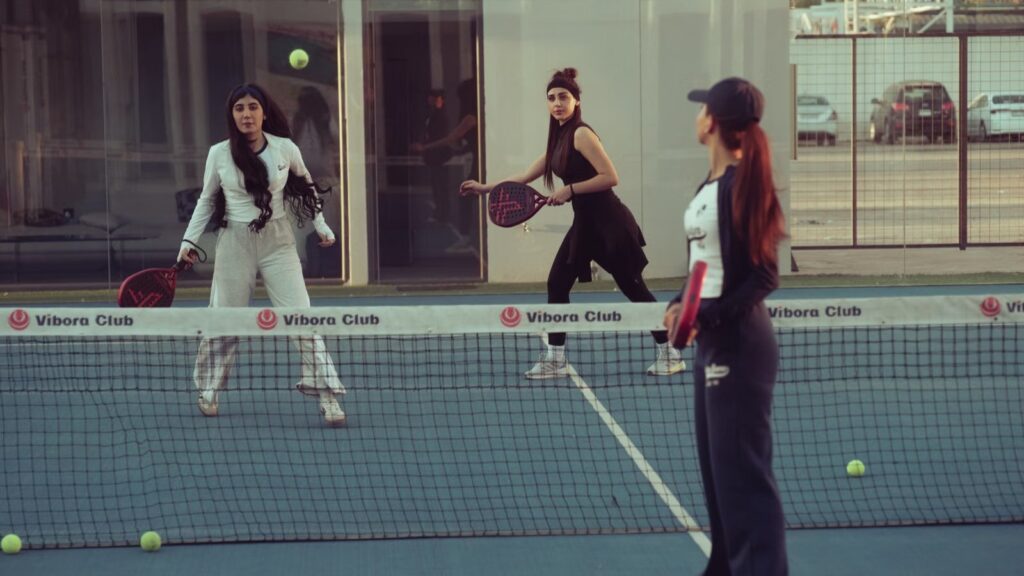

A padel court size is fixed by the rules at 20 metres long by 10 metres wide, which is roughly a third of the area of a tennis court. That small, enclosed space is also what makes the game so fast and so sociable. Around it, glass walls and mesh rise up to four metres high.
This guide covers every measurement, from the walls and net to the service lines and ceiling height, plus what it costs to build a court in the UK. If you are here because you play, these are the bits of kit worth having in your bag.
Kit for your next game

Balls
Bullpadel Premium Pro
Three tubes, so a group can open a fresh one each game.
Check price on Amazon

Grip
Palbea Overgrips
A multipack of tacky overgrips to keep your racket handle fresh.
Check price on AmazonAs an Amazon Associate I earn from qualifying purchases.
Padel court size at a glance
- Playing area: 20 m long by 10 m wide, 200 square metres.
- Back walls: 3 m of glass with 1 m of mesh above, 4 m in total.
- Net: 0.88 m high in the middle, 0.92 m at the posts.
- Service lines: 6.95 m from the net on each side.
- Indoor ceiling: at least 6 m clear, ideally 8 m.
- Singles court: 20 m by 6 m.
Padel court dimensions
| Part of the court | Measurement |
|---|---|
| Length | 20 m (about 65.6 ft) |
| Width | 10 m (about 32.8 ft) |
| Playing area | 200 square metres |
| Back walls | 3 m glass plus 1 m mesh, 4 m in total |
| Net height | 0.88 m in the middle, 0.92 m at the posts |
| Service line | 6.95 m from the net |
| Clear height above the court | 6 m minimum, 8 m recommended |
| Singles court | 20 m by 6 m |
In fact, these figures come from the LTA padel court guidance, which follows the international rules. As a result, every court you play on in the UK should match them, which is one reason the game feels the same from one club to the next.
The walls and the mesh
First of all, the back walls are the simplest part. Each is 3 metres of toughened glass, with 1 metre of metal mesh on top. The side walls, however, are stepped. Next to the back wall, the glass runs 3 metres high for the first 2 metres, then drops to 2 metres high for the next 2 metres. After that, the rest of the side is metal mesh.
This matters for the rules because the two surfaces behave differently. For instance, a ball that bounces and then hits the glass is still in play, but the mesh sends it off at odd angles. Meanwhile, some newer courts, known as panoramic or crystal courts, use glass for more of the sides, which gives spectators a clearer view. Our guide to padel rules explains what is in and out off each part of the wall.
Lines, net and service boxes
On the whole, the lines are simple compared with tennis. To begin with, a centre line runs from the net to each service line, splitting each half into two service boxes. The service lines are 6.95 metres from the net, leaving about 3 metres between the service line and the back glass.
Similarly, the net is 10 metres long and slightly lower in the middle, at 88 centimetres, rising to 92 centimetres at the posts. That small dip is why a ball hit across the middle of the court clears the net more easily.

Carry it all
HEAD Base Padel Bag
A compact bag with space for your racket, balls and shoes.
Indoor courts and ceiling height
Indoor courts need plenty of height, because lobs go a long way up. For that reason, the guidance asks for at least 6 metres of clear space above the court, and recommends 8 metres for new builds. Likewise, lights and beams should sit above that line, so they do not get in the way of play.
You also need space around the court. For example, doors in the side walls let players reach balls that leave the court, and there should be a clear area beyond them on courts that allow play outside. In practice, a single court needs a footprint noticeably larger than 20 by 10 metres once the frame and access are included.

10% off for our readers
Bags and accessories for your next game
Padel Boost stocks bags, grips and accessories from the main brands. Your 10% discount is applied when you click through.
Advert. We may earn a commission if you buy, at no cost to you. Discount code PADELREVIEW.
How much does a padel court cost to build?
Clearly, building a court is a serious project. According to the LTA, padel court projects in the UK typically cost between £60,000 and £270,000, depending on the number of courts, lighting, drainage and how much work the site needs. Meanwhile, industry figures put a single outdoor court at around £45,000 to £80,000, before any canopy or building to cover it.
In addition, most projects need planning permission, especially for floodlights or a roof. That is also a big reason most new courts in Britain are going in at clubs, gyms and leisure centres rather than in back gardens.
Padel court size compared with tennis and pickleball
| Court | Size |
|---|---|
| Padel | 20 m by 10 m |
| Tennis (doubles) | 23.77 m by 10.97 m, plus run off |
| Pickleball | 13.41 m by 6.1 m |
For more on how the three games compare, see our guide to padel vs tennis vs pickleball. To find a court near you, use our UK padel court finder.
Padel court size: your questions answered
How big is a padel court in feet?
About 65.6 feet long by 32.8 feet wide, which is the 20 by 10 metre standard converted.
Is a padel court smaller than a tennis court?
Yes. A padel court covers 200 square metres, while a doubles tennis court covers about 261 square metres before you add the run off around it. Therefore, you can fit roughly three padel courts in the space of one full tennis court and its surrounds.
How high is the ceiling for indoor padel?
At least 6 metres of clear height above the court, and 8 metres is recommended for new builds, so that lobs do not hit the roof.
How big is a singles padel court?
The same 20 metres long, but only 6 metres wide.
Can you build a padel court in your garden?
Only if you have the space and the budget. Firstly, you need at least 20 by 10 metres plus room around the court, and the walls are up to 4 metres high, which is well above the usual height allowed without planning permission. Check with your council before you spend anything.